
Tag: Building Operations

  • The Quiet Standard Behind Good Elevator Service

    The Quiet Standard Behind Good Elevator Service

    Why reliability and communication matter more than anything people usually measure.

    Most people don’t expect much from elevator service.

    Not because they don’t care. Because over time, the bar gets set by experience. Calls go unreturned. Timelines stay vague. Explanations are either too technical or not given at all. And eventually, that becomes normal.

    So when something actually works the way it should, it feels notable. It probably shouldn’t. But it does.

    The Expectation Problem

    We hear a version of the same thing from building managers and homeowners alike. By the time they call us, they’ve usually already adjusted to a lower standard. They’re not expecting great service. They’re hoping for adequate.

    That’s not a small thing. When expectations have been worn down enough, people stop asking for what they actually need. They accept vague timelines because they’ve learned that pushing back doesn’t help. They stop calling because nobody picks up anyway.

    The problem isn’t just poor service. It’s what poor service does to the relationship over time.

    What People Actually Remember

    Nobody remembers the service ticket number.

    They remember whether the elevator was working on a Monday morning when the building was full. They remember whether someone picked up when they called. They remember whether they got a straight answer or a runaround.

    We’ve talked to property managers who couldn’t tell us the last time their service provider proactively reached out about anything. Not a heads up before a scheduled repair. Not a follow up after a recurring issue. Nothing. The relationship only existed when something broke.

    That’s reactive service. And most people in commercial buildings and residential homes have experienced this.
    What Good Actually Looks Like

    Good service isn’t perfect service. Equipment breaks. Things happen. That’s not the standard.

    The standard is predictability. Knowing who to call and having them answer. Getting a clear explanation of what happened and what’s being done about it. Having issues addressed before they turn into emergencies.

    It’s not dramatic. It doesn’t announce itself. But over time it changes how a building runs and how the people in it feel about the systems they depend on every day.

    For a family with a home elevator, that predictability isn’t a convenience. It’s peace of mind. For a commercial building, it’s the difference between a minor inconvenience and a tenant relations problem.

    Why it Feels Rare

    Most service models are built to close tickets, not build relationships. The job is done when the repair is done. Whether the customer understands what happened, feels confident in the fix, or knows what to watch for next, that part is often left unaddressed.

    So things happen to buildings instead of being managed for them. And the people relying on the equipment are left filling in the gaps themselves.

    A Better Way to Think About It

    Elevator service doesn’t have to feel like a constant question mark in the background.

    When communication is consistent, when someone takes ownership, when the people relying on the equipment actually understand what’s being done and why, service stops being a source of anxiety and starts being something nobody has to think about.

    That’s the standard worth holding. Not perfection. Just consistency, clarity, and someone who actually picks up the phone.

    Most buildings and homes don’t need more service. They need better service. And once you know what that looks like, it’s a lot easier to see the gap between where things are and where they should be.

    If your service still feels like a question mark, it’s worth taking a closer look.
    Give us a call or schedule a time to meet, and we’ll help you sort through what’s actually happening.
  • Beyond the Sensor: What Elevator Data Is Actually Telling You

    Most buildings track elevator data. Few use it to understand what’s actually changing.

    Most buildings today are collecting more elevator data than ever before.

    But very little of it is being used to its full potential.

    Because most systems are designed to answer a simple question:

    “Is something wrong?”

    The more useful question is:

    “What is this system trying to tell us before anything breaks?”

    Not All Data Is Created Equal

    When people think about elevator monitoring, they usually think in terms of failures:

    • A fault code triggers
    • A component stops working
    • An alert gets sent

    That’s the obvious layer.

    But underneath that is a much quieter—and far more valuable—set of signals:

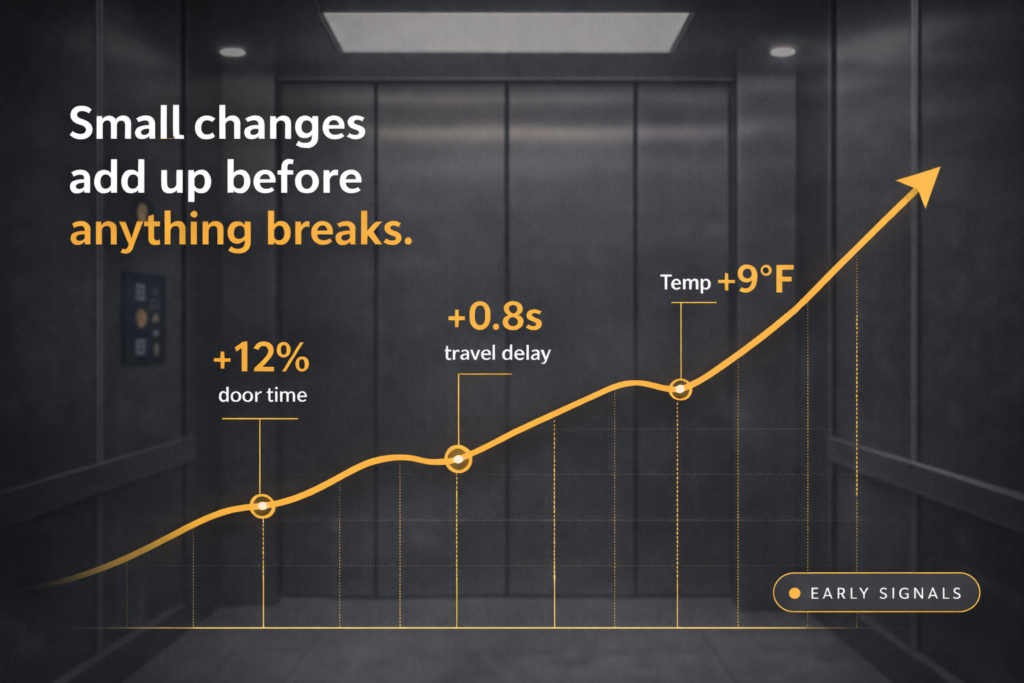
    • Slight increases in door dwell time
    • Small delays in floor-to-floor travel
    • Changes in motor temperature under similar load conditions
    • Irregular call patterns at certain times of day

    Individually, none of these mean much.

    But together, they start to form a pattern.

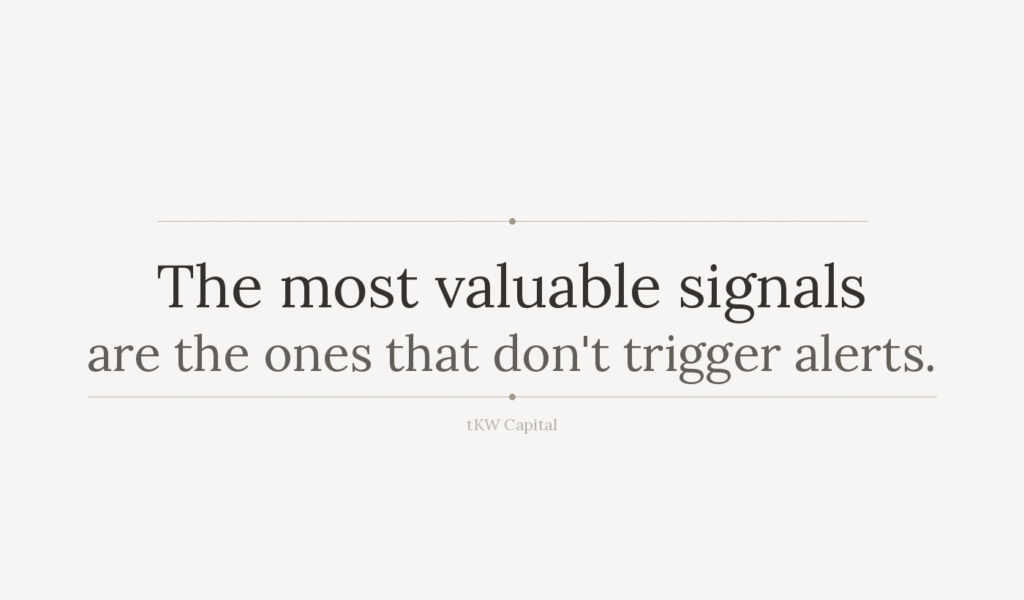
    Minimalist text graphic with the quote: “The most valuable signals are the ones that don’t trigger alerts.” on a light neutral background.

    Patterns Show Up Long Before Problems Do

    Most mechanical issues don’t appear suddenly.

    They develop gradually.

    A door operator doesn’t just fail—it starts closing a fraction of a second slower.
    A drive system doesn’t overheat instantly—it runs slightly warmer under the same demand.

    Here’s what that can look like in real terms:

    • Door cycle time increases by 12–18% over 60 days
      → Early sign of operator wear or alignment issues
    • Average trip time between floors increases by ~0.5–1 second during peak hours
      → Could indicate load strain, dispatch inefficiency, or control system lag
    • Motor temperature trends 8–10°F higher under the same usage conditions
      → Often a precursor to premature component failure
    • Call volume spikes at consistent times (e.g., 8:45–9:15 AM)
      → Not a mechanical issue—but a traffic flow or scheduling bottleneck

    None of these would typically trigger an urgent alert.

    But they’re often the first indicators that something is drifting.

    Elevator interior with upward trend graph showing early warning signals like increased door time, travel delay, and temperature before failure.

    What Most Buildings Are Missing

    Here’s the part that often goes overlooked:

    Elevator data isn’t just about maintenance.
    It’s about behavior.

    When you start looking at trends over time, you can begin to understand:

    • Which elevators are being overused—and when
    • Where traffic bottlenecks consistently form
    • Whether perceived “slowness” is mechanical or operational
    • How dispatch logic is actually performing in real-world conditions

    In some cases, the issue isn’t the equipment at all.

    It’s how the system is being used.

    And without the data, those distinctions are almost impossible to make.

    The Difference Between Activity and Insight

    Most buildings already have activity:

    • Logs
    • Alerts
    • Monthly service reports

    But insight requires something different.

    It requires context.

    Not just:
    “What happened?”

    But:

    • Is this trend consistent or isolated?
    • How does this compare to the last 30, 60, 90 days?
    • Is this happening across all cars—or just one?
    • Does this pattern correlate with time of day or traffic load?

    Without that layer, data becomes noise.

    With it, it becomes direction.

    How to Actually Use the Data (Without Overcomplicating It)

    You don’t need a complex system to start getting value.

    But you do need a more intentional way of looking at what you already have.

    Here are a few practical ways to begin:

    1. Track Trends, Not Just Events
    Instead of reviewing individual alerts, look at:

    • Door cycle times over time
    • Trip durations during peak vs off-peak
    • Repeated minor faults on the same component

    Even a simple monthly comparison can reveal drift.

    2. Review Data in 30–60–90 Day Windows
    Most issues don’t show up in a single report.

    Looking at rolling timeframes helps you spot:

    • Gradual performance decline
    • Seasonal or usage-based patterns
    • Recurring “almost problems”

    3. Separate Mechanical vs Usage Signals
    Not every issue is a repair issue.

    Ask:

    • Is this tied to equipment…or traffic flow?
    • Is one elevator carrying more load than others?
    • Are peak-time delays predictable?

    This can prevent unnecessary service calls—and uncover operational fixes instead.

    4. Identify “Repeat Offenders”
    If the same car or component keeps showing minor irregularities, that’s often more telling than one major failure.

    Small, repeated signals usually point to:

    • Early-stage wear
    • Misalignment
    • Or a system that’s compensating for something else

    5. Ask for Context, Not Just Reports
    Most service reports tell you what happened.

    Fewer explain what’s changing.

    A better question to ask is:

    “What are you seeing that isn’t a problem yet—but is trending that way?”

    That’s where the real value lives.

    Checklist graphic titled “How to Read Your Data” with steps including track trends, compare 30/60/90, and watch repeat patterns.

    Where This Changes Decision-Making

    When data is interpreted correctly, it starts to shift how decisions are made.

    Instead of reacting to failures, you start identifying:

    • Components that are wearing faster than expected
    • Systems under strain due to usage patterns
    • Opportunities to rebalance traffic or adjust performance

    It also changes how you think about cost.

    Because not all expenses are tied to breakdowns.

    Some are tied to inefficiencies that go unnoticed for years.

    The Bottom Line

    Elevator systems are constantly communicating.

    The question is whether anyone is actually listening beyond the obvious signals.

    The real value of data isn’t in catching failures.

    It’s in recognizing the patterns that lead to them—and the opportunities to improve before they ever show up.

  • The Hidden Costs of Elevator Downtime — And How Property Managers Can Quantify Them

    The Hidden Costs of Elevator Downtime — And How Property Managers Can Quantify Them

    For most commercial properties, an elevator being out of service is treated as a temporary inconvenience.

    But in reality, elevator downtime is rarely just a maintenance issue.
    It’s an operational disruption that creates costs across multiple parts of a property’s ecosystem.

    The challenge is that many of these costs don’t appear on a maintenance invoice.
    They show up in tenant frustration, operational delays, and long-term asset perception.

    When property managers begin to quantify these impacts, elevator uptime becomes less about fixing problems and more about protecting the performance of the entire building.

    Why Elevator Downtime Is More Expensive Than It Looks

    Most building owners evaluate downtime in simple terms:

    Repair cost + technician labor.

    But the broader financial picture is usually much larger.

    When elevators stop operating, they can trigger:

    • Tenant productivity disruptions
    • Increased wait times during peak hours
    • Service delays for deliveries and vendors
    • Accessibility challenges for certain occupants
    • Higher pressure on remaining elevators

    In multi-tenant buildings, the ripple effects can impact dozens or even hundreds of occupants at once.

    And when downtime becomes frequent or unpredictable, it begins to affect how tenants perceive the reliability of the entire property.

    Branching rope structure spreading outward like a network, illustrating how elevator downtime can create ripple effects that impact dozens or hundreds of building occupants.

    The Operational Ripple Effect

    Elevators function as circulatory systems within commercial buildings.

    When one unit goes down, the system rarely stops completely.
    Instead, the remaining elevators absorb the load.

    That often results in:

    • Longer wait times
    • Congestion during peak hours
    • Reduced efficiency moving tenants throughout the building

    In high-traffic environments, even a single elevator outage can shift traffic patterns across the entire building.

    What looks like a short interruption can quietly become a daily operational bottleneck.


    Quantifying the Hidden Costs

    To understand the real impact of elevator downtime, it helps to look beyond repair invoices and examine operational metrics.

    Property managers can begin estimating costs through a few key factors.

    1. Tenant Time Loss

    If a building houses 500 tenants and elevator wait times increase by just 3 minutes per trip, the cumulative productivity impact can add up quickly.

    Even small delays across hundreds of daily elevator trips can translate into significant lost time over the course of a year.

    2. Service and Delivery Delays

    Service vendors, maintenance teams, and deliveries all rely on elevators to move efficiently through a building.

    Downtime can slow these operations and create compounding delays across multiple services.

    3. Tenant Satisfaction and Retention

    While difficult to measure directly, building reliability plays a significant role in how tenants evaluate their space.

    Frequent elevator outages can quietly influence:

    • Tenant renewal decisions
    • Property reputation
    • Overall tenant experience

    In competitive leasing markets, operational reliability often becomes a differentiating factor.

    Family in a residential building navigating elevator delays, with one person waiting at the elevator holding groceries while another carries a child up the stairs.

    Why Downtime Often Goes Unnoticed Until It’s Frequent

    One reason these costs stay hidden is that downtime is often reactive rather than tracked strategically.

    Elevators are repaired when they fail, and operations resume shortly after.

    But without tracking patterns, it can be difficult to identify:

    • Recurring equipment issues
    • Increasing downtime frequency
    • System performance trends over time

    This is where modern elevator monitoring systems are beginning to change how buildings manage vertical transportation.

    Instead of reacting to failures, monitoring tools can help property managers:

    • Identify early warning signs
    • Track system performance
    • Reduce unplanned outages
    • Make more informed maintenance decisions

    The goal is not simply faster repairs.
    It’s fewer disruptions overall.

    Professionals walking through a modern office lobby with a city skyline in the background, illustrating the scale of tenants and operations affected by elevator downtime.

    From Reactive Repairs to Strategic Asset Management

    Elevators are long-life assets that play a central role in how a building operates.

    When downtime is viewed only as a repair issue, opportunities to improve reliability can be missed.

    But when it’s evaluated through an operational lens, elevators become part of a broader strategy focused on:

    • Tenant experience
    • Building efficiency
    • Long-term asset planning

    For many commercial properties, the most effective approach is shifting from reactive service calls toward data-driven monitoring and preventative maintenance.

    Because the true cost of downtime isn’t just fixing an elevator.

    It’s everything that happens while the building waits for it to come back online.

    Want to reduce unexpected elevator downtime?

    Aspire Elevator Co helps property owners and managers improve elevator reliability through monitoring, preventative maintenance planning, and long-term asset strategy.

    Contact our team to learn how we can help keep your building moving.